
PHRESCO (Physical Reservoir Computing Competition) is the world's first competition dedicated to exploring the frontiers of physical reservoir computing. We invite researchers, students, and interdisciplinary teams to demonstrate how physical systems—from soft materials and chemical systems to biological tissues or any complex physical structures—can be harnessed for computation, intelligence, and complex signal processing.
This is not just a contest; it's a collaborative research initiative and completely free. In this emerging field, your input will help define what counts as creativity, novelty, and significance.
What is Physical Reservoir Computing?
Physical Reservoir Computing (PhyRC) is a modern Machine Learning approach that uses nonlinear physical dynamics (e.g., water flow, laser dynamics, soft robotics bodies, etc.) as computational resources. We are currently preparing a set of introductionary videos to explain the underlying principles and we are also preparing a few examples for inspiration.
In the meantime, Another good way to get familiar with the topic is to read “Physical Reservoir Computing in Robotics”, which looks at how soft bodies of robots can be used. However, PhyRC goes way beyond that. The first ever physical reservoir computing work used a bucket of water, i.e., “Pattern Recognition in a Bucket” by Chrisantha Fernando & Sampsa Sojakka. A good overview is the book “Reservoir Computing - Theory, Physical Implementations, and Applications” edited by Kohei Nakajima and Ingo Fischer, which provides chapter on general reservoir computing, but also some about physical reservoir computing. Finally, have a look at Susan Stepney’s “Physical reservoir computing: a tutorial”.
Who should apply?
Academic researchers exploring novel computing paradigms
Students interested in unconventional computation
Cross-disciplinary teams (physics, materials science, neuroscience, engineering)
Independent researchers and enthusiasts with a passion for experimental systems
Everyone who is fascinated by physical reservoir computing
What will you submit and how do we judge?
In general, we want to keep the effort for all participants to a a minimum, while maximising the fun to be part of the competition. We are looking for highly creative ideas over performance.
For the final submission, participants will submit a short video (max 3 minutes) presenting the work and demonstrating their physical reservoir system in action, and an extended abstract (max 2 pages, excluding citations). Before final submission, participants are welcome to submit a preliminary abstract about their approach.
Submissions will be evaluated by our expert panel (TBD, the 2026 judges are: Benjamin Schrauwen, Herbert Jaeger, Susan Stepney). Creativity will be the main focus of the evaluation criteria.
To qualify, your submission must meet following minimum criteria:
The physical reservoir should exhibit both nonlinearity and memory. A quantitative benchmark is NARMA2 test as stated in our example, which are adapted from [1]. For the input signal, frequency scaling is allowed, but the ratio between the three base frequencies should be maintained. A Normalised Mean Square Error (NMSE) < 20% should be achieved with NARMA2 benchmark test. You can provide evidence by submitting the raw data.
Only a linear readout is allowed to generate the output from your system.
No artificial extensions of computational capabilities, e.g., additional memory or nonlinearities that are not part of the reservoir.
Extension of existing works is allowed, but novelty is paramount.
[1] Nakajima, Kohei, et al. "Information processing via physical soft body." Scientific reports 5.1 (2015): 10487.
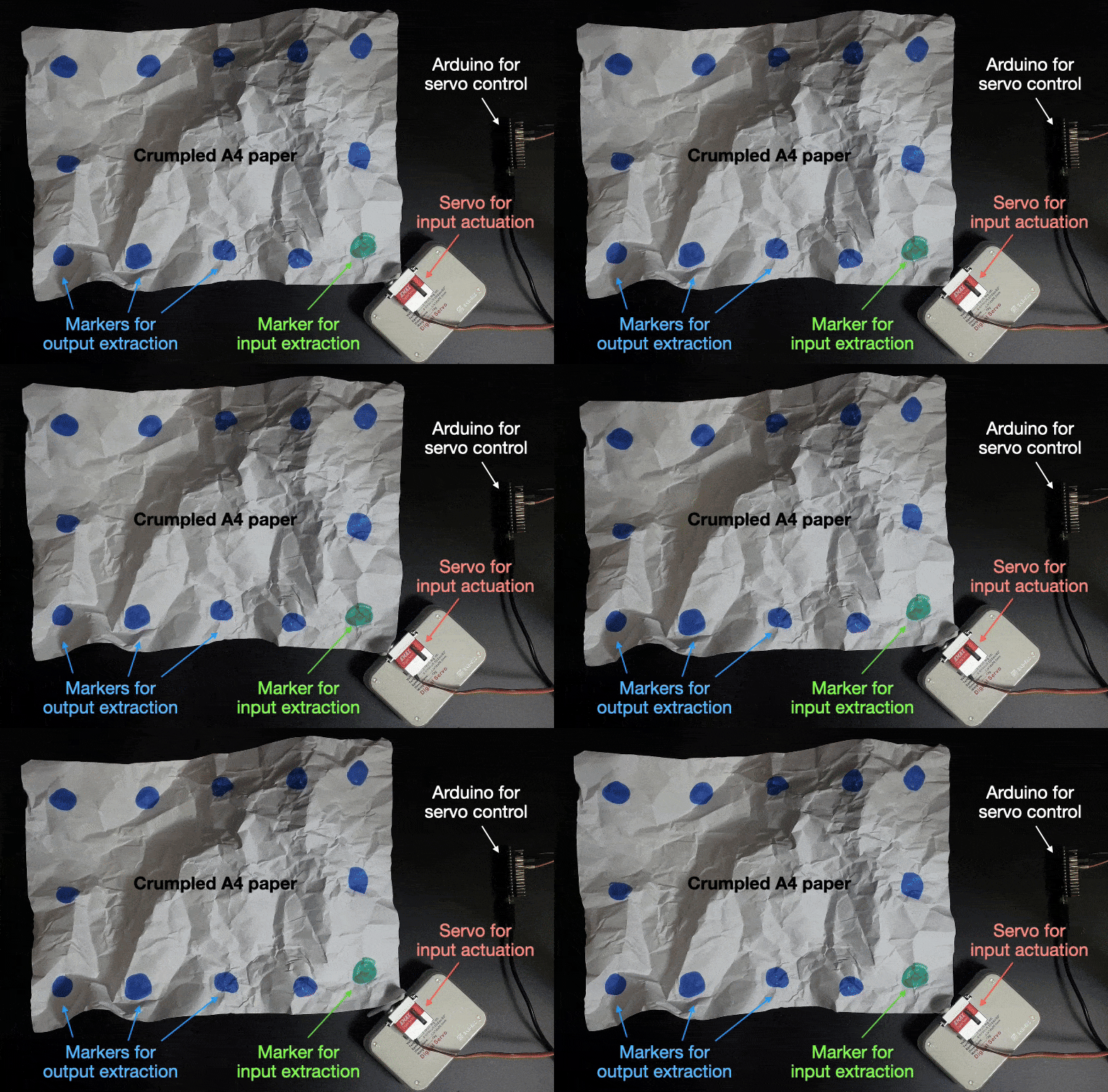
For further clarification, please refer to the example submission that illustrate acceptable implementations:
Time Line
Expression of Interest: Open now. Please sign up below!
Expression Of Interest Closes: 31st August 2026 23:59 (GMT) -> 30th November 2026 23:59 (GMT);
Preliminary Abstract Submission Closes: 15th December 2026 23:59 (GMT).
Submission Feedback: Feedback on abstract will be provided by end of January 2026.
Final Submission Deadline: TBD.
Award Ceremony: TBD, we are planning to hold the Award Ceremony at IEEE RoboSoft Conference (5–9 April 2027).
Sign up!
If you are interested, please sign